
You know fall has arrived when coffee shops start getting flooded with people only to get a hold of pumpkin spice lattes, and if you’re planning a fall trip to New England, that means peak foliage season (usually late September through mid-October) is right around the corner. It sets the mood perfectly with the New England fall foliage, as you might only have a week of snapping photos of your latte in front of beautiful bright red trees. But besides pumpkin spiced lattes, you’re probably wondering: when do the leaves start to fall? When is the best time to see fall colors in New England?
Late heat and early cold indicate vibrant foliage. These yellow, orange, red, and purple leaves scatter throughout areas with trees that produce chlorophyll during the summer. And for this reason, the pigment in the leaves changes color. But before the leaves fall off entirely, chase and capture the New England fall foliage to your fullest advantage.
If you want my free 5-day guide to chasing fall foliage in New England, download it here.
New England Fall Foliage Quick Facts (2026)
- Best time to go: Late September through mid-October for most of New England. Northern Vermont, New Hampshire’s White Mountains and far northern Maine usually peak first (late September to early October). Central New England follows (early to mid-October), and Boston, the coast and Connecticut can hold color into early November.
- 2026 outlook: Forecasters expect a gradual, stretched-out season rather than one sudden peak, after a snowy winter and timely summer rain helped trees recover from the 2025 drought.
- Busiest weekend: Indigenous Peoples’ Day weekend, October 10–12, 2026. Book lodging early.
- Sleepy Hollow Farm (Pomfret, VT): Private property. The Town of Pomfret is closing Cloudland Road to visitor traffic starting September 26, 2026 (through October 13).
- Flume Gorge (NH): Open through October 25, 2026. Reserve online: $18 for ages 13+ and $16 for ages 6–12 online, or $21 / $19 at the gate if tickets are left.
- Mount Washington Cog Railway (NH): Summit trips run through October 25, 2026. After that, trains go as far as Waumbek Station (4,000 ft).
- Smugglers Notch (VT): Route 108 is a narrow, seasonal road with hairpin turns and is not for large vehicles. Flying a drone from Vermont state park or state forest land requires written permission.
- Acadia National Park (ME): Driving Cadillac Summit Road requires a $6 timed vehicle reservation (May 20–October 25, 2026) on top of a park entrance pass.
- Mount Sugarloaf (MA): Open 9 a.m. to sunset. The summit road is open mid-May through mid-October, and parking costs $5 for Massachusetts residents or $20 for non-residents through October 12.
How to Plan for a Road Trip in New England During the Fall
I had lived on the East Coast my entire life but had never cared to explore New England during the fall season. The leaves on the trees will divert your focus as you’ll be gazing left and right for the brightest ones. But after getting into photography and scrolling through your Instagram feed, I’m sure you’ll want to explore the Northeast during the autumn season.
Heads up that if you’re a planner, don’t expect to follow your itinerary exactly as planned. In order to capture the peaks of the foliage, you pretty much have to “chase” after the colors. So, if you’re not a last minute type of traveler but want to experience the foliage, have a general route of where you want to go and what you want to see. When I flew into the Boston Logan International Airport in fall 2020, all we had were three days out of the 3-week trip planned.
But if you want to set plans that are longer than 3 days, when is the best time for the New England fall foliage? The best time to come see the fall foliage is from late September through mid-October.
Housing + Accommodations: Where to Stay for Fall Foliage in New England
Before your arrival, hopefully you have a car rental already secured. For a party of 4, we rented a minivan, which was perfect for the long road trip. For hotels, we booked our stays either the day before or the morning of and thankfully, there were enough hotels that weren’t sold out for the day. Some hotels that we preferred staying at did sell out, but I guess that’s what last minute planning does although we didn’t have an issue finding accommodations.
During our 3-week trip, we ended up staying at 11 places. These ranged from sleeping at hotels and Airbnbs to car camping at a Walmart parking lot for one night. On our 2020 trip, one night’s hotel stay cost us around $80 – $150 on average, so expect higher prices on peak foliage weekends now. If you’re traveling by yourself, hotel accommodations do get expensive, but that’s what Walmart parking lots are for! Whether you can car camp overnight at a Walmart is up to each store’s manager and local laws, so ask at the store before you settle in. Maybe you’ll find other travelers camping out to catch the New England fall foliage as well.

Consider Weather Conditions When Planning
While planning your autumn trip, don’t get bummed out if rain suddenly appears in your forecast. There’s a high chance of rainfall during your trip, but hopefully it doesn’t pour all day long. During our 3-week trip, it rained about 3-4 times, with another day of light rainfall during sunrise. Thankfully we took our chances and caught sunrise anyways.
If you’re in need of planning ahead, note that the colors don’t peak at the same time every year. There are a lot of factors that may allow the colors to peak earlier than the previous year, but it’d be good to update yourself on conditions starting from mid-September. But if you just need to put in your PTO days at work, I’d suggest booking a flight for the first two weeks of October as your safest bet.
>> Read More: How Often Do Travel Bloggers Actually Travel?
When Does Fall Foliage Peak in New England? (2026 by Region)
Color usually starts in the north and at higher elevations, then works its way south and toward the coast. Here’s what forecasters expect for 2026:
- Northern New England (Vermont’s Northeast Kingdom, New Hampshire’s White Mountains, far northern Maine): late September to early October
- Central New England (the Berkshires, northern Massachusetts): early to mid-October
- Southern New England (Boston, the South Coast, Cape Cod, coastal Connecticut): mid- to late October, sometimes into early November
This year is shaping up to be a slower, longer season than usual, which gives you more room to chase the color. Peaks still shift year to year, so check a live report a week before you go and again the morning of each drive:
What to Bring… (What to Pack for New England in the Fall)
Wherever you’re traveling from, note that temperatures vary from cold to warm throughout the day. There are going to be days where it’s okay with only a sweater, but there will also be days where you will need layers of jackets. It’s also colder in the mornings, so be prepared to layer up.
If you haven’t experienced chasing the New England fall foliage yet, I’d highly recommend bringing the items listed below to have you fully prepared. I don’t think I was entirely ready for the season, as I constantly had to borrow other people’s jackets. Thankfully, everyone else was more prepared than I was, although I could’ve easily walked into a Walmart or Target and purchased additional clothing.
But if you’re looking to take beautiful pictures with a little pop, you definitely want to consider bringing the outerwear pieces I’ve linked at the end of this post for your autumn road trip.
Because you’re going to be dealing with fluctuating weather, I can’t emphasize enough that you pack extra layers. I used every single item listed on the daily, as they completed the autumn look and feel.
I can’t emphasize enough: if you’re hiking early in the morning or after a killer sunset, bring a headlamp. Headlamps will save you from tripping over unexpected rocks and branches while getting down the trail, and they’ll also help prevent you from getting lost. It was a huge lesson I learned firsthand!
Where Are The Best Places to See The Fall Colors in New England?
Now for the fun part. You’re probably stoked to venture out on the hikes and gorges that provide beautiful aerial views of the autumn leaves. And for this reason, I’ve created a list of top destinations that are worth visiting, providing amazing scenic views when visiting during peak. Again, chasing after the New England fall foliage is like a game, as you’ll find yourself constantly checking Instagram Stories to ensure that conditions are peaking in real time. Listed are some of the best places to see the fall colors in New England:
1. Sleepy Hollow, Vermont
Known as one of the most photographed spots in Vermont, catching sunrise at Sleepy Hollow is worth those sleepless hours. Surrounded by dirt roads and big barns, prepare to set up your tripod next to 20 other photographers. Heads up: the farm is private property, and starting September 26, 2026 (through October 13), the Town of Pomfret is closing this stretch of Cloudland Road to visitor traffic, so check the Town of Pomfret’s notices for road and parking rules before you go.
There isn’t one particular “shot” at Sleepy Hollow as there are a ton of angles to shoot the big red barn from. You will find people taking photos right by the fence of the driveway, some getting higher ground on the street level, and others attempting to get as close to the house as they can.

2. Smugglers Notch, Vermont
Driving up a long winding road, make sure you have a drone to capture this road shot. Unfortunately, my drone had a software issue and didn’t work when we got to Smugglers Notch, but that just means I have to come back next year with it fixed. The aerial views of Smugglers Notch are what people drive up this road for, as they provide some of the most beautiful colors during peak. It’s also a popular tourist attraction so make sure to come early enough to find a place to park along the winding road.
Drone heads-up: flying from Vermont state park or state forest land, which covers much of the notch, requires written permission (a special use permit) from Vermont Forests, Parks & Recreation, so sort that out before your trip.
This notch is a mountain pass that separates Mount Mansfield, the highest peak of the Green Mountains, from Spruce Peak and the Sterling Range. There’s a lot of history behind this notch: it’s named for the Vermonters who smuggled goods to and from Canada through the pass after Thomas Jefferson’s Embargo Act of 1807 banned trade with Britain and Canada. But who knew that Smugglers Notch was going to end up as a popular photographed New England fall foliage spot back then?

3. Flume Gorge, New Hampshire
Known for its famous red covered bridge, Flume Gorge is a hot spot for visitors during the fall season. Approximately taking 1.5 hours to go around the entire loop, get ready to walk up and down a handful of stairs. If you plan your trip correctly and go during the peaks of the New England fall foliage, you’ll feel as if you’re walking through a patch of rainbow leaves. It’s a beautiful and relaxing walk as you’ll take pictures of the walk every few minutes. These trees are just so difficult to ignore!
Make sure that before arriving to Flume Gorge, you have tickets purchased in advance. Tickets at the gate cost more and aren’t guaranteed, and specific time slots can sell out on busy fall days, so book online a few days in advance. Even if you’re budgeting, purchasing these tickets is well worth the visit as there are a handful of stunning waterfalls and walkways along the walk.
Hours of Operation (2026 season, May 8 – October 25):
9 AM – 5 PM through October 12
9 AM – 4 PM from October 13 – 25
Ticket Pricing (2026, online / at the gate):
Ages 13 and over: $18 / $21
Ages 6 – 12: $16 / $19
Ages 5 and under: free

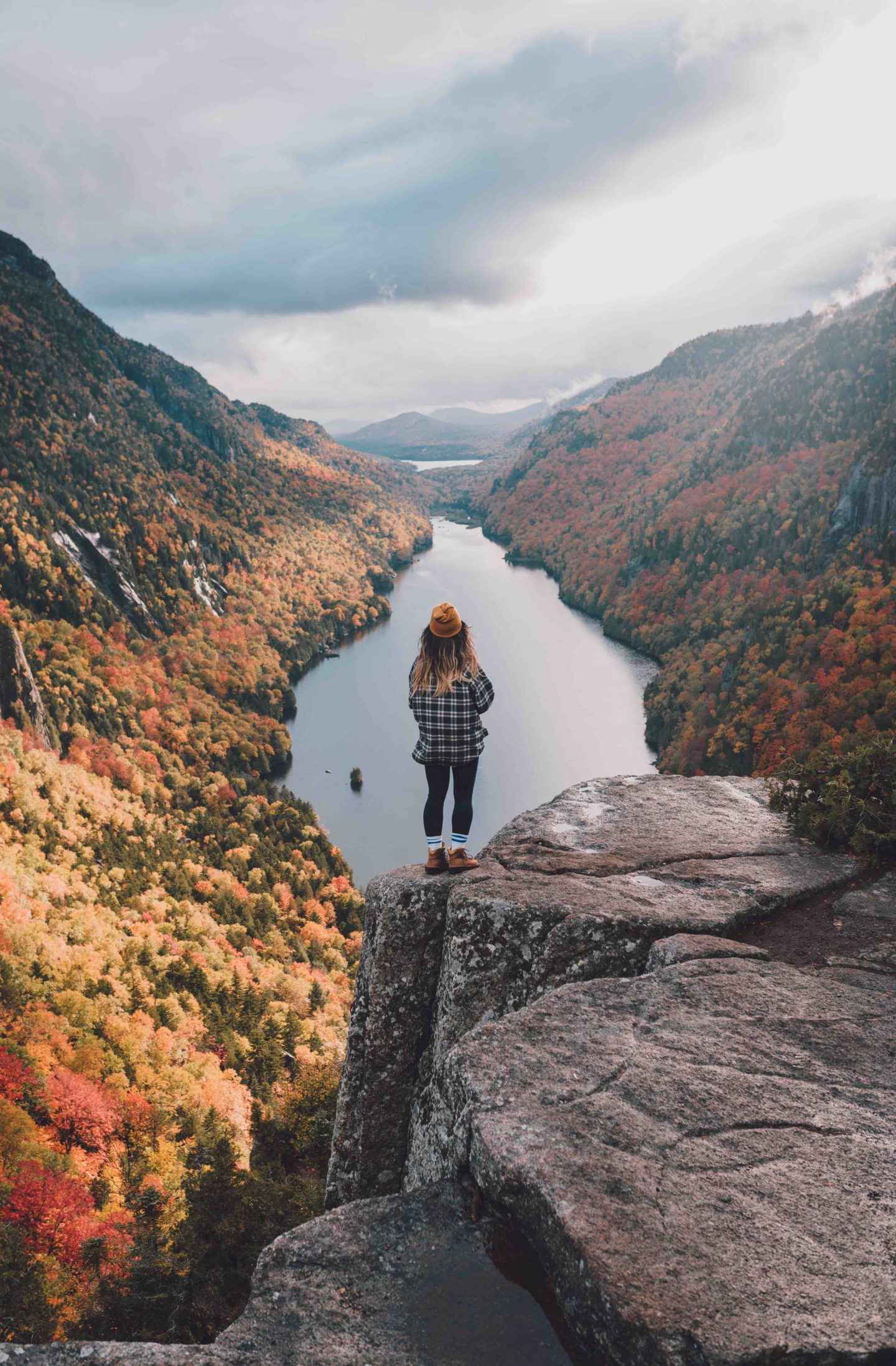
4. Adirondack Mountains, New York
Filled with jaw dropping views, the Adirondacks is full of beautiful hikes. Knowing that I will probably be getting a ton of people asking where the exact hike is, the locals have kindly asked to not share the location. They are worried about the potential traffic the crowds will cause, as parking is extremely limited. But if you are hiking this trail, please be mindful and follow The Seven Principles of Leave No Trace, providing an understanding of minimum impact practices for visitors.
When you get to the trail, make sure to come early enough to avoid parking tickets as it gets extremely crowded. There are rangers who man the area, giving out parking tickets along no parking zone areas. There are two parking lots, one closer to the trail and one across the street. You will also find people parking their car about a mile away from the entrance of the trail. And although the last parking option is far, the holistic experience is worth every minute.
Exploring the New England fall foliage without getting to the top of this trail just wouldn’t be complete. Round trip, you’re looking at around a 10-mile venture loop, with a 1,677 ft elevation gain. Note that before getting to the top, expect to walk about 45 minutes along a long, concrete road. The walk back might seem endless, but trust me. You’re going the right way back.
5. Stowe, Vermont
Known for its outdoorsy activities, wandering around the artsy town and visiting all the white churches are staples you don’t want to miss out on. Stowe is a special place as the town is filled with brilliant foliage and coffee shops serving delicious pumpkin spiced lattes.
Driving through the scenic highways is an activity to partake in as you’ll randomly find yourself pulling off to the side to take photos. Consider flipping through Go Stowe’s Scenic Drives Guide for suggested driving routes with exact direction.
With guided, self guided tours and festive events during the peaks of the autumn season, Stowe is a place you want to explore during your trip. In Vermont, Stowe is popularly known for having some of the most booked hotels during the fall season. This goes to show how special of a place it is to capture the best of the New England fall foliage.

6. Kancamagus Highway, New Hampshire
Filled with epic road shots, driving through the Kancamagus Highway is an experience in itself. Don’t forget to fill up your gas tank because the drive is 34.5 miles long with many off road shots. Filled with a ton of scenic areas and trailheads along the drive, keep an eye out for places to park off the side. And when you safely park to take photos, be prepared to encounter hundreds of cars driving through the road, getting in the middle of your shots.
We pulled off the road about three times and each time, we spent about 20 minutes running on and off the road just to get our highway shots of the road without any cars. Took more time than we thought, but the pictures were all worth it in the end. It also helps if you have a car watcher on the side of the road screaming to let you know that cars are coming.
Safety note: park only in designated pullouts and stay out of the travel lanes. No shot is worth getting hit by a car.

7. The Mount Washington Cog Railway, New Hampshire
Make a reservation to go on a ride along the Mount Washington Cog Railway. If we had a bit more time, riding along the scenic routes of New Hampshire in a train would’ve been an amazing experience. For solo travelers and families alike, this train ride will be extremely fun for everyone. Round trip, the ride is just under 3 hours with an elevation to 6,288 ft in approximately 45 minutes. Enjoy this smoothly running experience as the rides run seasonally.
2026 note: summit trips run through October 25, 2026. After that, trains go as far as Waumbek Station (4,000 ft). Foliage-season trains often sell out, so book ahead.
Ticket Pricing: fares change, so check current prices on The Cog’s official ticket page before you book.
Departing from the Marshfield Base Station, biodiesel trains leave about every hour, and steam trains leave at 9:00 AM and 2:45 PM on select days. Check the schedule when you book.

8. Crawford Notch Mountains, New Hampshire
Overlooking the beautiful Crawford Notch, this 3.2-mile round trip hike provides beautiful views featuring a small waterfall on the left once getting to the top. Dogs are permitted on this trail as the pathway to get to the top is pretty defined. The trail is pretty rocky, but wouldn’t label it as a challenging hike. Round trip, the hike takes around 2 hours with a 908 ft elevation gain. There’s a ton of parking right across train tracks so if you’re an inexperienced hiker, you’ll have no problem finding the entrance.
Although this trail is prime during the fall season, it’s pretty popular during the winter season as well. You’ll be getting different landscape views, but it depends if you want to see the New England fall foliage or patches of snow.

9. Acadia National Park, Maine
Located in the coastal parts of Maine, visiting Acadia National Park should be listed on top of your New England travel guide list. With a number of beautiful hikes and trails in Acadia, Bar Harbor, and Schoodic, you’ll undoubtedly witness some of the best fall foliage.
Therefore, the best time to visit Acadia National Park is in the late spring and fall. Keep in mind that although it gets busy during this time, you can’t beat great fall conditions. In total, 3-4 days is enough time to spend in Acadia, but it all really depends on what you’re trying to accomplish on your trip. Are you looking to hike? Are you looking to try out restaurants? But if you ask me, visiting Acadia will be well worth your time, as again, the conditions are super unique and you’ll surely witness the most vibrant fall leaves.
Unfortunately, we were unable to add Acadia National Park, but it will probably be the first place we visit on our next fall trip.
2026 note: to drive up Cadillac Summit Road between May 20 and October 25, 2026, you need a $6 timed vehicle reservation on top of your park entrance pass. Most reservations are released two days ahead at 10 a.m. ET on the official Acadia reservation page.

10. Mount Sugarloaf State Reservation, Massachusetts
Located right by the University of Massachusetts in Amherst, Mount Sugarloaf is a beautiful park with some of the most amazing views of the Connecticut River. With a tower in the middle of the park, swing by and get a hold of higher views of the park, or bring a basket of food to enjoy a picnic while overlooking an amazing sunset.
There are a number of hikes along the path that can be found on the official Mount Sugarloaf State Reservation site. The picnic pavilion can be reserved, but there’s no camping at the park. Keep in mind that park hours are from 9:00AM – sunset. So if you’re trying to capture a beautiful sunset, come during golden hour (about an hour before sunset) and take your snaps. We were the last group to leave the park, as we were attempting to capture the landscape with the least amount of sunlight.
2026 note: the summit road is open mid-May through mid-October, and parking costs $5 for Massachusetts residents or $20 for non-residents through October 12. The summit observation tower is open from late spring through foliage season.

Overall Experience
Even if you might not be a huge fan of the cold, experiencing the fall foliage in the east coast provides a unique experience you really can’t get anywhere else in the world. Requiring flexibility and a passion for nature, chasing the New England fall foliage is a trip of a lifetime. Whether you choose to travel solo or with a group whose goals align with yours, get ready to layer up and indulge in large amounts of pumpkin spiced lattes and apple cider.
Because of the experience with the people I traveled with, you bet that I plan on heading over to the east coast every fall season. The ambiance, activities, hikes, and seasonal vibes encountered are total vibes as the life of a leaf has limited time before falling off their roots. Remember to also seize all the opportunities presented to you as it’s possible for the leaves to fall off the trees in a matter of days. It blew my mind (literally) that some places visited lost their color in such a short period of time.
As long as you remember to back up your photos after the end of each day, you’ll have enough photos and content to edit throughout your trip chasing the New England fall foliage.
New England Fall Foliage FAQ
When is the best time to see fall foliage in New England?
Late September through mid-October. Northern Vermont, New Hampshire’s White Mountains and far northern Maine usually peak first, central New England follows in early to mid-October, and Boston and the coast can hold color into early November. If you just need to lock in your PTO, the first two weeks of October are your safest bet.
When do the leaves start changing in New England?
Usually mid- to late September up north, with swamp maples sometimes turning as early as late August. Forecasters expect a slower, longer season in 2026, so start checking the foliage reports in mid-September.
Where should I go leaf peeping in New England in the fall?
My top picks are Smugglers Notch and Stowe in Vermont; Flume Gorge, the Kancamagus Highway, the Mount Washington Cog Railway and Crawford Notch in New Hampshire; Acadia National Park in Maine; and Mount Sugarloaf in Massachusetts. With extra time, the Adirondacks in New York are worth the detour.
What are people who travel to see fall foliage called?
Leaf peepers! If you spend your trip refreshing Instagram Stories to see where the colors are peaking, you’re officially one of them.
What should I pack for New England in the fall?
Layers. Mornings are cold and afternoons can get warm, so bring a sweater, a warm jacket, comfortable boots and a headlamp for sunrise and sunset hikes. My full packing list is linked below.
What are the best things to do in New England in October?
Hike Crawford Notch, walk Flume Gorge, drive the Kancamagus Highway, ride the Mount Washington Cog Railway (summit trips run through October 25, 2026), wander around Stowe and catch sunset from Mount Sugarloaf. And yes, drink all the pumpkin spice lattes and apple cider.
Are New England fall foliage tours suitable for solo travelers?
Yes. Stowe has guided and self-guided tours during peak season, and the Cog Railway is fun for solo travelers and families alike. The main downside of going solo is cost, since you won’t be splitting hotel rooms. My solo travel tips can help you plan.
Shop My Fall Foliage Packing List
This section contains affiliate links. If you buy or book through them, I may earn a small commission at no extra cost to you. As an Amazon Associate, I earn from qualifying purchases.
>> Check out my hiking essentials when chasing foliage


Don’t forget to get yourself a copy of the COMPLETE New England Travel Guide!

Travel Guide: Fall in New England
What you can expect in this travel guide:
- Top recommended hikes with best views
- Exact itinerary + additional spots
- Exact coordinates on Google Maps
- 30 pages of detailed information
- Interactive packing list
- Recommended camera gear
- Hotel, restaurant + cafe recommendations
- …and so much more!
YOU MIGHT ALSO ENJOY…
- Read This Before Visiting The Vessel, NYC
- Travel Tips and Advice For Solo Travelers
- Chasing Fall Foliage in Colorado: Best Places to See Fall Colors
- Wild Lights: The Best Place To Visit in Upstate New York During the Winter
- Sony a6400 Review: Best Travel Size Camera for Beginner Vloggers + Photographers
- Airplane Home: Visit The Man Who Lives in a Boeing 727
Pin This!

Leave a Reply